J IS FOR JUNK ECONOMICS: A Guide To Reality In An Age Of Deception by Hudson Michael
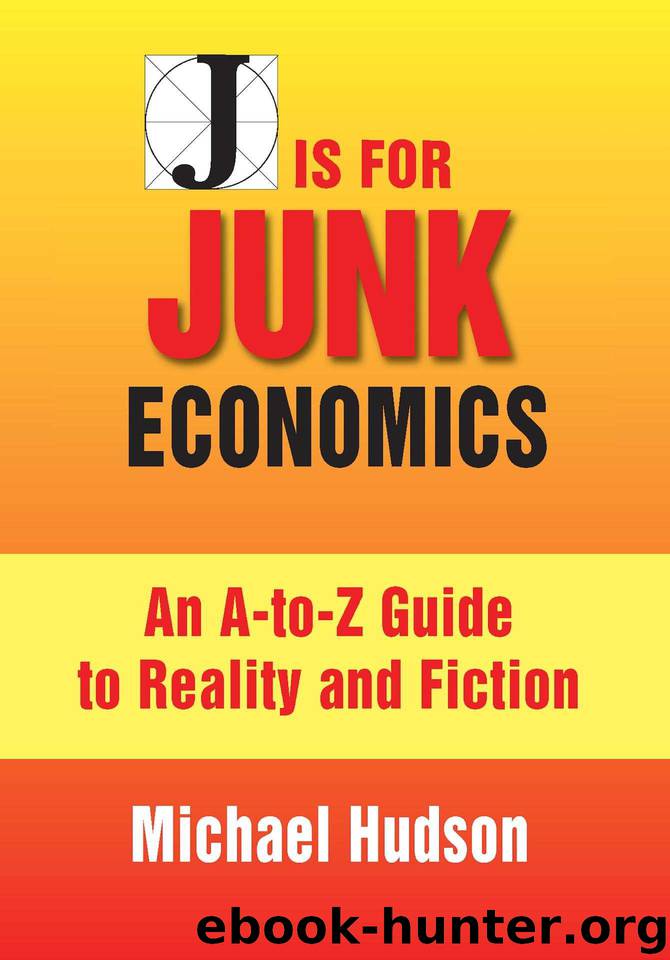
Author:Hudson, Michael [Hudson, Michael]
Language: eng
Format: mobi
Publisher: ISLET/Verlag
Published: 2017-05-25T04:00:00+00:00
The cover story enabling universities to raise their fees is that lending to students finds its counterpart in “human capital” yielding a higher income on educational “capital.” But government-guaranteed education loans have led to a proliferation of for-profit diploma mills, whose courses have little linkage to training of the sort that actually increases income. In any case, most of the increase in earnings by graduates must now be turned over to banks, as interest on their student loans. The fruits of “human capital” thus end up enriching finance capital.
Super Profits: Excessive returns beyond what is necessary to induce capital investment and employment. See Monopoly Rent (e.g., in information technology, health insurance, oil and gas).
Supply-Side Economics: A rationale for cutting taxes on finance and property (see FIRE Sector). The Laffer Curve, named for Republican economic advisor Arthur Laffer, pretends that the deeper taxes are cut, the more tax revenue can be collected. The cover story is that high-income recipients will have less incentive to cheat or hide their profits abroad in offshore tax havens – as if their accountants don’t always try to keep every dollar of profit away from government. The actual result of such tax cuts is a deepening budget deficit, creating pressure to raise taxes on labor and consumers to rebalance the budget.
The pretense is that what needs to be “supplied” to spur economic growth are tax cuts (see Tax Shift) and hence more net income for the higher tax brackets. The false assumption is that leaving the One Percent with more income will be an incentive for them to undertake more capital investment and job creation.
The sophistry continues by promising that inasmuch as corporations and rich people employ labor, cutting their taxes will enable them to employ more workers. (See Trickle-Down Economics.) This implies that the wealthy will create jobs by investing their gains in new production – not outsourcing, downsizing, looting pension funds and driving the economy into debt (see Financialization). Such lobbyists never mention corporate raiders, downsizing or outsourcing jobs.
What is “supplied” is simply more income, asset-price gains and hence political power to the vested interests, leaving them with yet more to lend back to the increasingly indebted 99 Percent. The effect is to shrink output and employment, and deterring rather than inducing new capital investment.
Sustainability: An economy’s ability to be resilient and supply its members’ basic needs while preserving environmental balance (avoiding pollution, depletion and climate change), financial balance (avoiding debt overhead, fraud and bad loans or toxic mortgages) and demographic balance (avoiding austerity that drives skilled labor to emigrate and older labor to die early from suicide and reduced health care). As such, sustainability is the antithesis to debt deflation, neoliberalism and supply-side economics.
Systems Analysis: A technique for viewing the impact of any given change on all parts of the economic, political and social system, based on positive feedback such as increasing returns, or damping negative feedback (diminishing returns). What neoclassical economics dismisses as externalities often turn out to be most important for the overall social system, e.
Download
This site does not store any files on its server. We only index and link to content provided by other sites. Please contact the content providers to delete copyright contents if any and email us, we'll remove relevant links or contents immediately.
International Integration of the Brazilian Economy by Elias C. Grivoyannis(102998)
The Radium Girls by Kate Moore(11989)
Turbulence by E. J. Noyes(7994)
Nudge - Improving Decisions about Health, Wealth, and Happiness by Thaler Sunstein(7671)
The Black Swan by Nassim Nicholas Taleb(7073)
Rich Dad Poor Dad by Robert T. Kiyosaki(6545)
Pioneering Portfolio Management by David F. Swensen(6264)
Man-made Catastrophes and Risk Information Concealment by Dmitry Chernov & Didier Sornette(5966)
Zero to One by Peter Thiel(5749)
Secrecy World by Jake Bernstein(4714)
Millionaire: The Philanderer, Gambler, and Duelist Who Invented Modern Finance by Janet Gleeson(4433)
The Age of Surveillance Capitalism by Shoshana Zuboff(4260)
Skin in the Game by Nassim Nicholas Taleb(4213)
The Money Culture by Michael Lewis(4152)
Bullshit Jobs by David Graeber(4151)
Skin in the Game: Hidden Asymmetries in Daily Life by Nassim Nicholas Taleb(3970)
The Dhandho Investor by Mohnish Pabrai(3731)
The Wisdom of Finance by Mihir Desai(3707)
Blockchain Basics by Daniel Drescher(3553)
